Computing
Intent
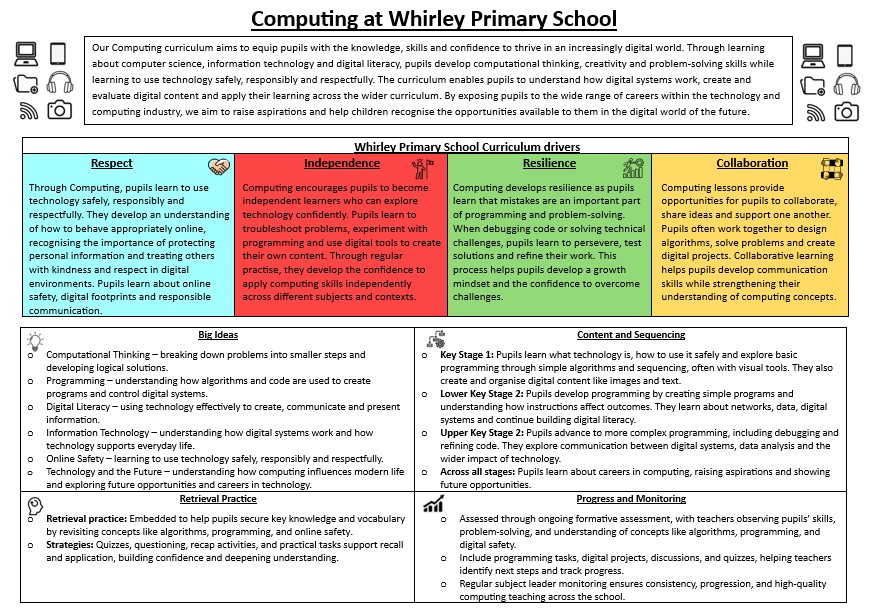
When planning and teaching computing at Whirley Primary School, we believe that it is an essential part of the curriculum; a subject that not only stands alone but is woven through all parts of all learning. Computing, in general, is a significant part of everyone’s daily life and children should be at the forefront of new technology, with a thirst for learning what is out there. Computing within schools can therefore provide a wealth of learning opportunities and transferrable skills explicitly within the Computing lesson and across other curriculum subjects.
Through the study of Computing, children will be able to develop a wide range of fundamental skills, knowledge and understanding that will equip them for the rest of their life. Children must be taught in the art form of ‘Computational Thinking’ in order to provide them essential knowledge that will enable them to participate effectively and safely in the digital world beyond our gates.
Reception
In Reception we build on knowledge gained in pre-school settings and home environments. Children will seek to acquire basic skills in turning on and operating some ICT equipment. We do this through the exploration of basic equipment such as torches and remote-control devises. The children also learn to use a track pad to navigate simple games on a laptop, such as Phonics Play. The children enjoy interacting with age-appropriate computer software both on the IWB and on touch screen devices too.
Year 1
In Year 1, children build upon their reception skills of using a mouse by learning how to login and navigate around a computer, further developing their mouse skills as they learn how to drag, drop, click and control their cursor. Moving on from this, children then begin to explore how Bee-bots work by programming them to follow specific directions. Further to this, children are introduced to the language ‘algorithm’ and use this vocabulary to create their own set of instructions, ensuring they are clear enough to follow. At this point, children start to notice that algorithms do not always work, and we begin to work on decomposition and debugging within familiar contexts.
Furthermore, children will have the opportunity to develop their data handling skills by using a computer to create pictograms and charts, branch databases and classifying.
Year 2
Building on from Year 1, children will learn how to edit text, with a significant period of time is spent developing their efficiency and accuracy using a keyboard and improving their touch-typing skills in preparation for creating larger bodies of text when they move into Key Stage 2. Also building on their Year 1 data handling skills, children will explore how to use data to create spreadsheets. The ability to store and retrieve information is embedded at this time.
As the children begin to use the internet for research purposes across the curriculum, the children are taught how to use the internet (and search engines such as google) safely. At this time, it is made explicitly clear how important it is to communicate with their parents and guardians about all online activity. Building upon this, children begin to understand the role of computers and that they form part of a network.
Building on from early algorithm work in Year 1, the children are introduced to the software scratch junior. This gives the children the opportunity to create a computerised intervention and learn basic coding skills in preparation for Key Stage 2.
Year 3
Building on from their previous learning about computer science in Year 2, in Year 3 children revise that a computer is made up of different components. They then begin understanding what the different components of a computer do and how they work together. They also have an opportunity to draw comparisons across different types of computers before learning about the purpose of a server and what a server does.
Developing their coding skills further, children continue to explore scratch creating more challenging algorithms and learning how to use loops to improve programming.
Building on their data handling skills in Year 2, children will learn the meanings of records, fields and data. Further exploration will lead to the development of the ideas of sorting and filtering.
Year 4
Children begin by learning what the internet is and how it works, in particular how data is transferred and how this enables us to view and interact with websites. They will begin to understand of what a ‘responsible digital citizen’ is, children will change HTML tags and CSS codes to alter images and texts in order to create a ‘fake news’ story. Children will then learn about the benefits of collaborative tools including Google Docs, Slides, Forms and Sheets and understand how the internet allows people to work together despite being physically afar.
Building upon programming skills from Year 3, pupils will explore and apply their computational thinking creating simple games using scratch and learning about different code blocks and other variables. They will also build on their data handling skills by researching and storing data using spreadsheets, designing a weather station which gathers and records data and learning how weather forecasts are made.
Year 5
Children begin by learning what a search engine is and understanding why keywords and phrases are important, identifying inaccurate information and recognising the terms ‘copyright and ‘fair use’. Children make parallels between book searching and internet searching, explaining the role of web crawlers and recognising that results are rated to decide rank.
Building on children previous programming skills, children will us Sonic Pi to compose music. They will begin to understand that using loops can make the process of writing music simpler and more effective.
Building on their data handling skills, children will identify some of the types of data that the Mars Rover collects and explaining how the Mars Rover transmits the data back to Earth. Children will read binary numbers, and understand binary addition as well as identifying input, processing and output on the Mars Rovers.
A new skill that children will learn this year is creating digital media using stop motion software. Children will learn how to program to plan and tell a story using and editing photo software.
Year 6
In Year 6, children begin by building upon their knowledge of the 8-bit binary code and start using Python to create their own designs, tinkering with the coding values to create different shapes. They will then move on to discovering the history of Bletchley Park, historical figures, and computer science. Children learn about code-breaking and password hacking as well as decoding messages. Children present information about historical figures.
Further exploring their data handling skills, they will understanding data usage through the use of mobile data vs WiFi, the Internet of Things, and big data. Identifying high/low data activities and preparing presentations on using Big Data/IoT to improve school efficiency while respecting privacy. Building on their digital media skills taught the previous year, children will then begin to write, record and edit radio plays set during WWII, looking back in time at how computers have evolved and designing a computer of the future.